

Workshop discussions and research findings to culminate in a shared resource on increased sustainability of cultural practices, biodiversity and livelihoods in cultural landscapes
By Seline Meijer and Barbara Nakangu, The International Union for Conservation of Nature (IUCN)
In March 2020, the International Union for Conservation of Nature (IUCN) and ANP/WWF Portugal organized a workshop in Lisbon, Portugal. The aim of the workshop was to bring together experts and M6 partners from the project landscapes to explore the economic practices and options that can sustain or improve the viability of cultural practices that support cultural landscapes across the Mediterranean. The workshop provided participants with an opportunity to take stock of their progress, assess unique and shared opportunities and challenges,
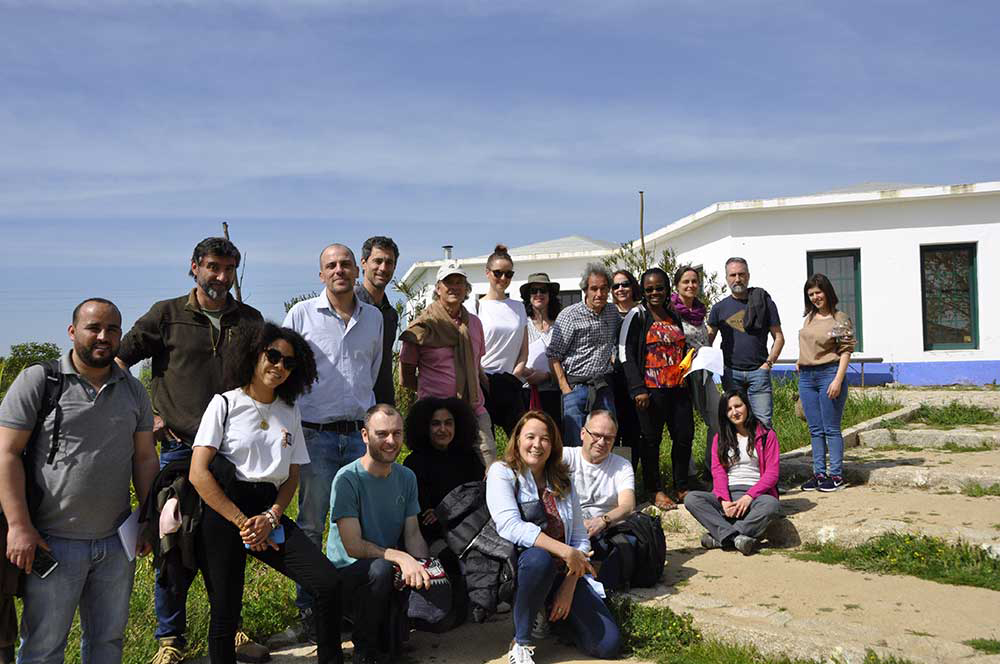
At a workshop held in March 2020, project partners explore economic practices and options that can sustain or improve the viability of cultural practices that support cultural landscapes across the Mediterranean.
and identify common areas for improvements, learning, and collaboration. As part of the workshop, there was a field visit to Herdade do Freixo do Meio, a local organic farm and food cooperative inspired by the traditional “montado” farming system, which is closely linked to the ancient Portuguese oak forest. Since 1997, the estate has been producing food in a way more adapted to the natural local conditions and more efficient in terms of environmental costs, attentive to the social reality and following agroecology and food sovereignty principles. This includes organic and biodynamic farming, as well as permaculture techniques. Learning about the unique philosophy and seeing the methods used on the farm first hand was a source of inspiration and discussion for the group.
The information shared at the workshop has been synthesized in a Lessons Learnt report, along with the research findings from the different economic studies that have been undertaken in the landscapes over the past years, to inform future work. The report provides recommendations for developing market initiatives that can lead to improvements and increased sustainability of cultural practices, biodiversity and livelihoods in the focus landscapes. The findings of the report, which will be launched in September, include:
- The main point of agreement is the need to leverage cultural practices to create a common identity around the sustainable management of landscapes.
- There are shared challenges around defining specific practices for promoting shared values and successfully transmitting the value of these practices to a large number of consumers. The involvement of consumers in the formulation of sustainable production practices as “co-producers” can allow consumers to feel a stronger sense of connection to the farmers and breeders from whom they get their food.
- Questions remain around the feasibility of both formal third-party certification schemes as well as informal labelling schemes, since the market is already saturated by labels and they can sometimes give misleading information about products, which might confuse consumers.
- Sustainable tourism and other complementary income generating activities can play a role in local economics, if they complement and support traditional practices.
- Cooks, chefs, and private sector companies can play an important role in helping producers communicate the value of their products and practices. However, the main responsibility is in the hands of the communities and producers that live in and shape cultural landscapes.